Categories
Postwar 0 Gauge

Lionel 2452 Gondola 1945-47

Lionel 2452 Gondola

The 2452 gondola was Lionel’s first plastic bodied train. The 2954 semi scale boxcar and the Madison cars introduced in 1940 were made of Bakalite. Bakalite is molded from granulated material. The material is compressed and heated to form the car.

The 2452 is made of a dense styrene plastic. Styrene is molded by forcing liquid material into a mold.

Anyway, the 2452 gondola comes in two basic versions. The O gauge 2452 has brakewheels and came with wooden barrels. The 0-27 gauge 2452X has no brakewheels, and didn’t come with barrels.

There are a lot of different versions of this car having to do with the mold – earliest bodies have three round holes in the floor, while later bodies have a large rectangular hole. The holes are for the electronic receiver used on the 4452 gondola.

There is also a lettering variation. The G27 is either small or large. Large is later. None of the variations mentioned above effect the value of the car.

There is another variation that does effect the value. The trucks. The 1945 cars come with flying shoe trucks. The pick up for the uncoupler is open. Later cars have a metal plate under the entire truck to provide support for the shoe.

2452 gondola with flying shoe trucks

Two versions of flying shoe trucks were made. The earliest versions have wheels with spirals on the backs – “Whirley wheels,” while later flying shoe trucks have plain backs. Plain backs are shown above.

Flying shoe trucks double the value of this car. A 2452 with whirley wheels can bring 4 times the value of a standard gondola.

Categories
Postwar 0 Gauge

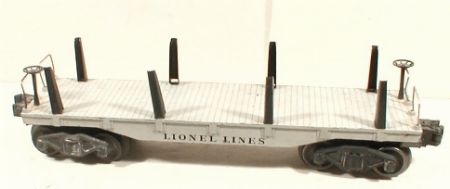
Lionel 2411 Flatcar 1946-48

Lionel 2411 flatcar

Lionel introduced the 2411 flat car in 1946 as the “Big Inch Pipe Car.” It came with 3 blackened steel pipes. These pipes are hard to find today and are worth more than the flatcar.

In 1947 and 1948 the 2411 came with wood logs. These are the same logs used on the 164 log loader.

The 2411 flatcar is very common. It’s all metal and looks great with any train. In 1949 the trucks were changed to the new magnetic type and the 2411 was renumbered to the 6411.

Categories
Postwar 0 Gauge

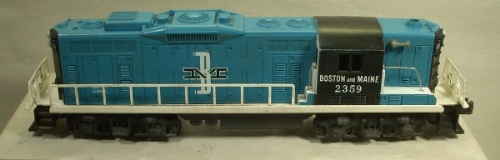
Lionel Boston And Maine GP-9 Loco 2359 1961-62 and 2346 1965-66

Lionel 2359 B&M gp-9 switcher

Lionel made the 2359 Boston and Maine GP-9 in 1961 and 62. There are no variations of this loco.

As a side note, the difference between a GP-7 and a GP-9 is the addition of a dynamic brake to the top of the cab.

In 1965 the B&M diesel loco reappeared in the catalog as the 2346 loco. The 2346 Boston and Maine GP-9 was cataloged in 1965 and 66.

Both versions are equally available today and neither commands a premium.

Categories
Postwar 0 Gauge

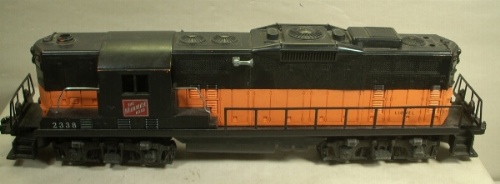
Lionel 2338 Milwaukee GP-7 Loco 1955-56

Lionel 2338 Milwaukee loco

Lionel introduced the 2339 Milwaukee geep in 1955. The first versions came with an orange cab. Later versions came with a black cab as shown above.

I think the orange cab versions come in boxes marked 2338X. The orange cab is worth considerably more than the black cab.

Categories
Postwar 0 Gauge

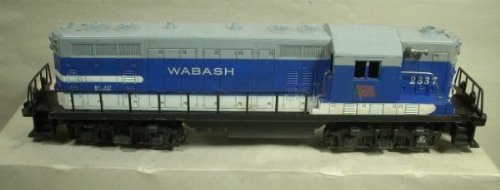
Lionel 2337, 2339 Wabash GP-7 Loco 1957-58

Lionel 2337 Wabash loco

Lionel made two versions of the Wabash geep.

The Lionel 2339 Wabash GP-7 was cataloged in 1957 only. It was an O gauge engine and was available in sets or by itself.

The 2337 GP-7 was made in 1958, and cataloged as an 0-27 loco. Most 0-27 locos only came in sets, and 0-27 sets came with track and transformer.

The two engines are identical except for the number on the hood. Neither version is harder to find, but the 2339 is slightly more desirable than the 2337.

Categories
Postwar 0 Gauge

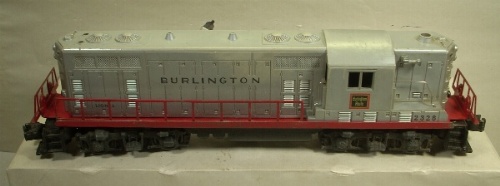
Lionel 2328 Burlington GP-7 Loco 1955-56

Lionel 2328 Burlington GP-7

The Lionel 2328 Burlington GP-7 was offered in 1955 and 1956. This is one of the most common of the Lionel geeps.

There are no variations of the 2328.

The aluminum paint Lionel used in the postwar period is water based, and cannot be cleaned. A 2328 Burlington like the one shown above will sell for $50-70 because the paint is faded. An unfaded and uncleaned loco will sell for 5-8 times as much.

Categories
Postwar 0 Gauge

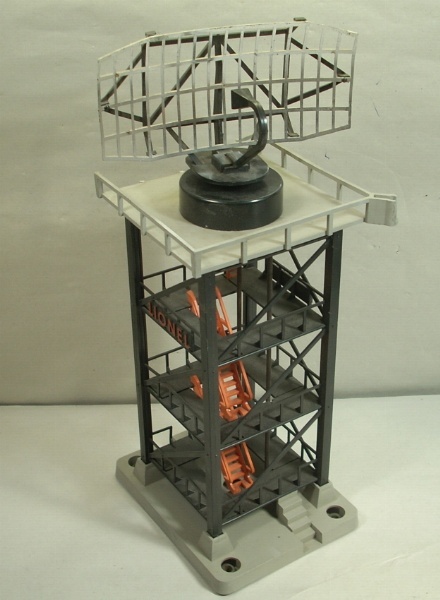
Lionel Radar Antenna 1958-59

Lionel 197 Radar Tower

Lionel introduced the 197 radar antenna in 1958. It was offered again in 1959 and then canceled. It was made with gray or orange base. The orange base is harder to find. The gray base is shown above.

The rotating antenna and the guardrails are usually broken. Replacement parts are available.

The 197 radar tower has been reissued by both Lionel and MTH.

Categories
Prewar Standard gauge

Lionel 402 and 402E Locomotive 1923-29

Lionel peacock 402 Locomotive

Lionel introduced the 402 electric locomotive in 1923. In 1926 the 2-position e unit was added and it became the 402E. It was only available with an automatic reverse in 1928 and 29.

The 402 replaced the 42 as Lionel’s largest standard gauge locomotive. The first version had stamped steel lights with on/off switches. Later locos came with diecast headlights. All 402E locos came with cast headlights.

The 402 is found with at least three versions of the numberplate – all black lettering, black center with red outline, and all red lettering. (Supposedly red lettering was only used on locomotives with e units, but the 402 is an exception.)

Lionel peacock 402 Locomotive

This loco was was only cataloged in mohave, but was made in other colors. I’ve heard of peacock, mustard brown, dark gray, maroon and red are colors.

The odd colors could be paint samples or special orders. Before 1929 Lionel would paint any item in any

regularly used color as a special order. Lionel service order forms show this option.

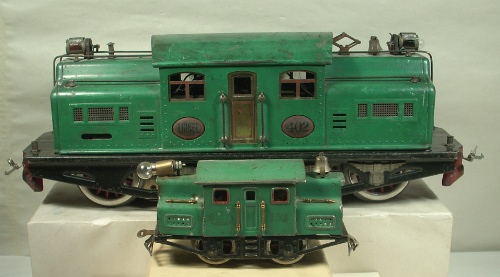
Shown here in peacock, this locomotive dates from 1923-25 based on the lights and the red border on the number plates.

This blue 402 is filthy. The color looks off because it has a coat of oil residue. This is commonly seen on trains stored unpacked in basements with coal or oil burners.

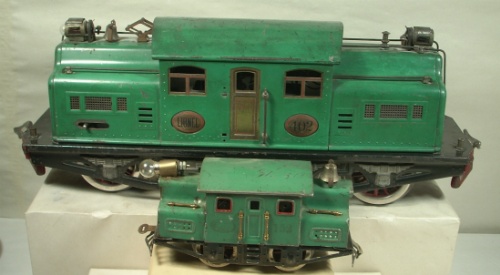
Here’s a picture of the 402 with a peacock 152 inside it for a color comparison. The peacock 152 is also an odd colored locomotive.

Lionel peacock 402 Locomotive

I’ll put pictures of my mohave 402 loco up here in the future.

Categories
Prewar 0 Gauge

Lionel 700K Scale Hudson Kit 1939-42

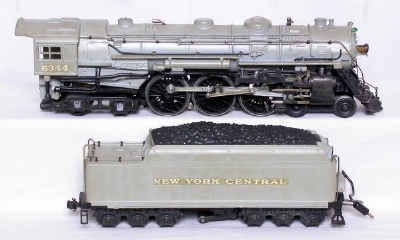
Lionel 700K Kit Hudson Assembled In Primer Grey

In 1937 Lionel introduced the famous 700E Hudson locomotive. This was a scale 1:48 model of the New York Central steam locomotive. The assembled 700E came with a walnut display stand and was the first commercially produced die cast O scale locomotive made.

The 700E Hudson was very popular with the newly emerging O scale operators. By the mid 1930s a movement towards scale or realistic locomotives had grown up in the US and many operators built kits. Factory
assembled scale locomotives and cars weren’t available. So the Lionel Hudson was a first.

In 1939 to accommodate O scalers who wanted to build their own locomotive Lionel began offering the 700E in kit form. 5 kits built the locomotive and tender, and a sixth kit contained a whistle for the tender.

The kits could be built for inside or outside third rail.

To make it easier for modelers on a budget, Lionel sold the kits separately. Some modelers built the locomotive and never painted it black so there are a few original gray 700K locos out there. (The one shown at the top of this page is an original kit locomotive assembled and unpainted.)

I always wanted to build a 700K so since I had acquired most of the parts I decided to build my own Hudson kit.

The first kit 700K-1 came with the frame with wheels mounted, the crossheads and valve gear need to be mounted.

I lost the picture of the frame before adding parts, but you can see it under the trimmed boiler shown in the third kit.

This portion was a mess. Because I was using parts from junk Hudsons I used the best of each part I had and bought the missing parts. The frame I used came from a 763E so this loco has blind center drivers.

I had Don Hagar replace one of the wheels and straighten the frame. The wheel Don replaced broke in the mail on the way back so the frame had to make a return trip. Don didn’t charge me for the shipping or the work required to replace the wheel.

This whole process of getting the frame ready to mount the valve gear took 2 months acquiring the parts and dealing with the broken wheels.

Then I sat down to start putting the parts in kit 1 on, and the cranks and crankshafts on the parts engines were either modified or broken. I ordered replacements from Sal Olsen.

Sal sent me the wrong rivets to attach the cranks to the crankshafts, and one of the cranks was defective. Another month as the parts went back and forth.

Everything sat in boxes for months waiting for the parts. Some of the time was occupied by other pursuits, but it was quite frustrating to sit down and start working only to realize something was missing or broken.

If I wasn’t already bald I would have been pulling out my hair.

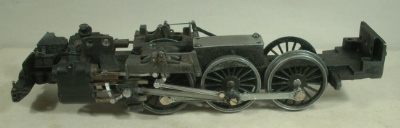
Anyway I finally got kit 1 put together. Here’s both sides after the assembly of kit 1:
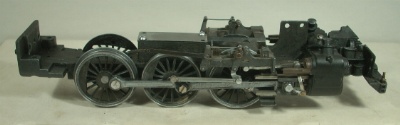
700K-1 frame assembled

700K frame with valve gear

The second kit 700K-2 included the motor, e unit, collectors – inside and outside, the headlight and a lead weight.

The second kit went together in minutes. I test ran the loco to make sure everything was correct only to find a short in the e-unit. I don’t have an e-unit to cannibalize for parts so I decided to temporarily wire the engine without the e-unit so it only runs forward.

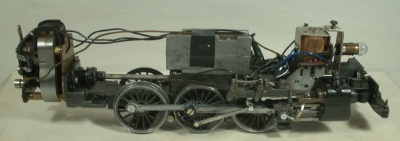
Here’s photos of both sides after the parts in kit 2 have been added to the frame:
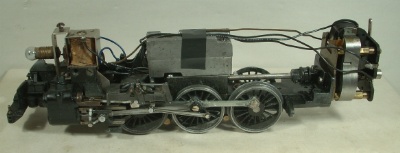
700K frame with motor

700K-3 assembled

The third kit contained the boiler and cab assembly and all the trim. Below is a photo of a Hudsonboiler without the trim installed.
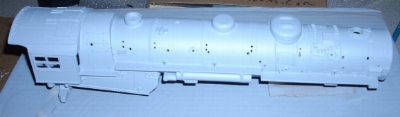
700K boiler unpainted

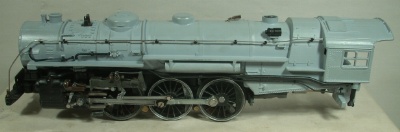
I added the trim to the boiler while I was waiting for the frame parts. Here’s both sides of the boiler after mounting trim. I set the boiler on the frame before the parts in kits 1 and 2 were added to the frame for these pictures.
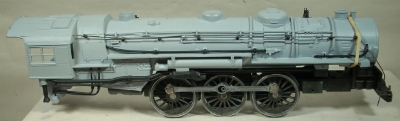
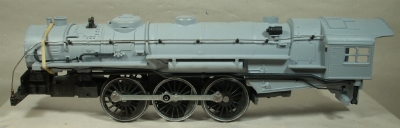
700K boiler primer gray with trim

700K boiler primer gray with trim

The next step is mounting the boiler to the frame. Another short showed in a wire coming off a brush at this point. The original wire is cloth covered and it was pinched between the cab and the frame. I’ll
rewire it when I put the new e-unit in.

Here’s pictures of the trimmed cab mounted on the frame with valve gear from step 2:
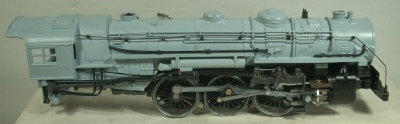
700K boiler mounted on frame

700K boiler mounted on frame

Kit 700K-4 contained the ash pan, ladders, coupler and pilot, boiler front, lead and trailing trucks and some small bits of valve gear that attach to the boiler.

These parts were easy to mount. Because I used a 763E frame, I don’t have the holes to mount the coupler chain assembly. When I pull it apart to mount the e-unit I’ll drill the holes and mount the coupler chain. The boiler front also needs the lower grab irons.

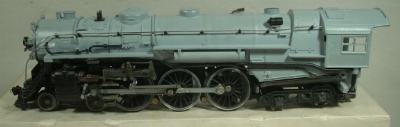
I did get the rest of the loco assembled, and here’s pictures of each side:
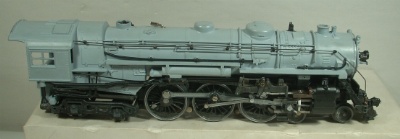
700K finished model

700K finished model before painting

Now I am supposed to take the whole thing apart and paint it black. Not going to happen. I do have the decals and will letter it in the future.

Kit 700K-5 contains the tender, and kit 700K-6 contained the whistle. I have a tender in my box of parts, but I don’t want to repaint a nice looking tender so this loco won’t have a matching tender until I find a restorable 700T tender. Got one?
Categories
Postwar 0 Gauge

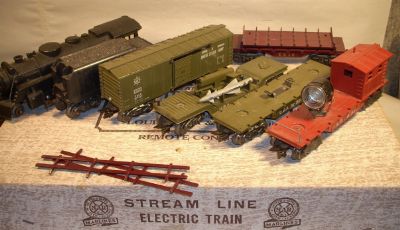
Marx 52960 Plastic Army Set 1958

Marx Plastic Army Set

This is a 1958 Marx 52960 army set. (The set box is dated August 1958 on the bottom.) The Army sets are quite desirable. The plastic ones don’t have as big a following as the earlier tin lithographed sets, but are still among the most desirable of the plastic Marx trains.

This is a less desirable set because it doesn’t have a green engine or tender, but the set contains some desirable cars.

The loco is just a common 666 with an even commoner Santa Fe tender. The caboose is a deluxe Santa Fe work caboose with search light. The Erie automatic electric log dump car is a neat operating car but has no place in an Army set.

The 2858 boxcar and 2824 rocket launcher are desirable cars. I’ve included individual photos below.

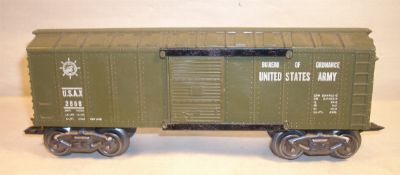
Marx 2858 Army Ordinance Boxcar

The Marx 2858 United States Army Bureau Of Ordinance boxcar is the most desirable plastic Marx military car. Just drab olive green with white lettering. It does have a sliding door though.

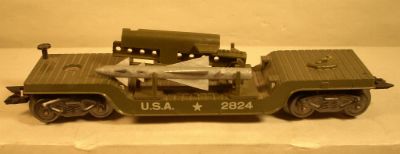
Marx 2824 Army Rocket Launcher Flat

The Marx 2824 Army Rocket Launcher Flat is an action car. There should be three rockets with the car shown above, but they’ve gotten lost somewhere over the past 50 years. There should also be a green man on the right side of the car, but he went AWOL.

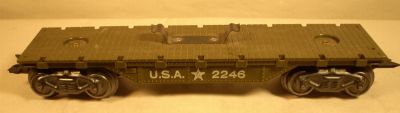
Marx 2246 Army Flatcar With Trucks

The Marx 2246 Army Flatcar came with silver plastic trucks or jeeps. These are missing from the car shown above. They were probably driven off by the man missing from the rocket flat car and his drinking buddies.

This set is very desirable because of the boxcar. Any Marx collector would be excited to get a set like this.